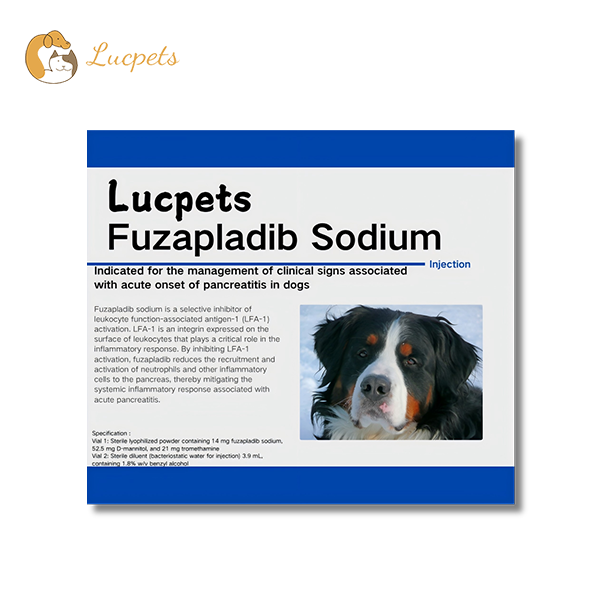
Product Name: Fuzapladib Sodium for Injection
Strength: Fuzapladib Sodium 14 mg per vial
Vial 1: Sterile lyophilized powder containing 14 mg fuzapladib sodium, 52.5 mg D-mannitol, and 21 mg tromethamine
Vial 2: Sterile diluent (bacteriostatic water for injection) 3.9 mL, containing 1.8% w/v benzyl alcohol
For Use In: Dogs only
Actions & Indications:
Fuzapladib Sodium – A selective leukocyte function-associated antigen-1 (LFA-1) activation inhibitor
Indications:
Fuzapladib Sodium for Injection is indicated for the management of clinical signs associated with acute onset of pancreatitis in dogs.
Dosage:
0.4 mg (0.1 mL) per kg
Once daily for 3 consecutive days
|
Body weight (kg)
|
Dose (mg)
|
Volume to Administer (mL)
|
|
2.5
|
1.0
|
0.25
|
|
5.0
|
2.0
|
0.50
|
|
7.5
|
3.0
|
0.75
|
|
10.0
|
4.0
|
1.00
|
|
12.5
|
5.0
|
1.25
|
|
15.0
|
6.0
|
1.50
|
|
20.0
|
8.0
|
2.00
|
|
25.0
|
10.0
|
2.50
|
|
30.0
|
12.0
|
3.00
|
|
35.0
|
14.0
|
3.50
|
|
40.0
|
16.0
|
4.00
|
Reconstitution Procedures
Items needed:
Sterile lyophilized powder vial
Sterile diluent vial
Sterile 5 mL syringe for transfer of diluent
Sterile needle
Steps:
1.Using a sterile needle and syringe, withdraw 3.5 mL of the sterile diluent from the diluent vial
2.Slowly transfer the sterile diluent into the vial containing the sterile lyophilized powder through the stopper
3.Remove the needle and syringe from the vial. Discard unused diluent, syringe, and needle
4.Gently swirl the vial until the powder is fully reconstituted into solution, leaving no visible residue or undissolved material
5.Before each use, gently swirl to ensure a uniform solution
6.Draw up the appropriate dose using a new sterile needle and syringe
7.Administer the dose promptly after drawing into the dosing syringe
Note:
More sterile diluent is supplied than the 3.5 mL needed for reconstitution
No other diluent should be used
Storage After Reconstitution
|
Condition
|
Temperature
|
Stability
|
|
Refrigerated
|
36°F to 46°F (2°C to 8°C)
|
28 days
|
Mechanism of Action:
Fuzapladib sodium is a selective inhibitor of leukocyte function-associated antigen-1 (LFA-1) activation. LFA-1 is an integrin expressed on the surface of leukocytes that plays a critical role in the inflammatory response. By inhibiting LFA-1 activation, fuzapladib reduces the recruitment and activation of neutrophils and other inflammatory cells to the pancreas, thereby mitigating the systemic inflammatory response associated with acute pancreatitis
Clinical Context:
Acute pancreatitis is a common inflammatory condition in dogs characterized by premature activation of digestive enzymes within the pancreas, leading to autodigestion, inflammation, and potential systemic complications. The inflammatory process recruits neutrophils and other leukocytes, releasing cytokines that exacerbate tissue damage. Fuzapladib targets the LFA-1-mediated leukocyte migration to interrupt this inflammatory cascade.
Contraindications:
Do not use in dogs with a known hypersensitivity to fuzapladib sodium
Warnings:
Fuzapladib sodium is a selective inhibitor of leukocyte function-associated antigen-1 (LFA-1) activation. LFA-1 is an integrin expressed on the surface of leukocytes that plays a critical role in the inflammatory response. By inhibiting LFA-1 activation, fuzapladib reduces the recruitment and activation of neutrophils and other inflammatory cells to the pancreas, thereby mitigating the systemic inflammatory response associated with acute pancreatitis
Clinical Context:
User Safety Warnings
Not for use in humans. Keep out of reach of children
Accidental self-injection: Seek medical advice immediately and show the package insert or label to the physician
Accidental skin contact: Wash the exposed skin with water for at least 15 minutes. If redness and swelling occur, seek medical advice immediately
Accidental eye exposure: Wash eyes with water for at least 15 minutes. If wearing contact lenses, rinse first, then remove and continue rinsing
Accidental ingestion: Rinse mouth with water. Do not induce vomiting unless directed by medical personnel. Seek medical advice immediately
Pregnancy/Breastfeeding: Limited data on teratogenic effects. Pregnant, breastfeeding, or women planning to become pregnant should avoid direct contact
Hypersensitivity: Anyone with known hypersensitivity to fuzapladib sodium or any excipients should avoid contact
Adverse Reactions
Adverse events reported in clinical study (n=31 fuzapladib-treated dogs)
|
Adverse Event
|
Fuzapladib (n=31)
|
Placebo (n=30)
|
|
Anorexia
|
5 (16.1%)
|
2 (6.7%)
|
|
Digestive tract disorders
|
5 (16.1%)
|
3 (10.0%)
|
|
Respiratory tract disorders
|
4 (12.9%)
|
3 (10.0%)
|
|
Hepatopathy, jaundice
|
4 (12.9%)
|
2 (6.7%)
|
|
Abnormal urine
|
3 (9.7%)
|
2 (6.7%)
|
|
Diarrhea
|
3 (9.7%)
|
1 (3.3%)
|
|
Arrhythmia
|
2 (6.5%)
|
1 (3.3%)
|
|
Cardiac arrest
|
2 (6.5%)
|
0
|
|
Hyperthermia
|
2 (6.5%)
|
0
|
|
Pruritus, urticaria
|
2 (6.5%)
|
0
|
|
Hypersalivation
|
2 (6.5%)
|
0
|
|
Anaphylaxis
|
1 (3.2%)
|
0
|
|
Cerebral edema
|
1 (3.2%)
|
0
|
Digestive tract disorders included regurgitation, vomiting, flatulence, nausea
Respiratory tract disorders included pneumonia, inspiratory crackles, tachypnea, dyspnea
Abnormal urine included proteinuria, hematuria, malodorous urine
Other observed events:
Heart murmur (1 fuzapladib, 2 placebo)
Limb edema (1 fuzapladib, 2 placebo)
SC swelling, bruising at injection site (1 fuzapladib, 1 placebo)
Tremor/shivering/shaking (1 fuzapladib, 1 placebo)
Hypertension (1 fuzapladib
Precautions:
Fuzapladib sodium is a selective inhibitor of leukocyte function-associated antigen-1 (LFA-1) activation. LFA-1 is an integrin expressed on the surface of leukocytes that plays a critical role in the inflammatory response. By inhibiting LFA-1 activation, fuzapladib reduces the recruitment and activation of neutrophils and other inflammatory cells to the pancreas, thereby mitigating the systemic inflammatory response associated with acute pancreatitis
Clinical Context:
Protein Binding:
It is highly protein bound
Use with caution with other medications that are highly protein bound (e.g., NSAIDs, anti-emetics, antibiotics, diuretics, behavioral medications)
Concomitant use with other protein-bound drugs has not been studied in dogs
Populations Not Evaluated
|
Population
|
Safety Status
|
|
Dogs with cardiac disease
|
Not evaluated
|
|
Dogs with hepatic failure
|
Not evaluated
|
|
Dogs with renal impairment
|
Not evaluated
|
|
Pregnant dogs
|
Not evaluated
|
|
Lactating dogs
|
Not evaluated
|
|
Dogs intended for breeding
|
Not evaluated
|
|
Dogs less than 6 months of age
|
Not evaluated
|
Concurrent Medications:
Concurrent medications used during the pilot effectiveness study included, but were not limited to, pain medications (excluding NSAIDs), antiemetics, parasiticides, vaccinations, and medications used to treat well-controlled pre-existing conditions.
Drug Interactions:
Due to high protein binding, potential for displacement interactions with other highly protein-bound drugs
Drug compatibility should be monitored in patients requiring adjunctive therapy
Concomitant use with NSAIDs has not been studied
Withdrawal Period:
Not applicable (for companion animals)
Package:
Each carton contains:
One vial of sterile lyophilized powder (14 mg fuzapladib sodium)
One vial of sterile diluent (3.9 mL bacteriostatic water for injection)
Storage:
Unopened kits (dry powder):
Store at controlled room temperature
Reconstituted product:
Refrigerated at 36°F to 46°F (2°C to 8°C)
Stable for 28 days
Shelf Life:
Refer to packaging expiry date
For animal use only.